Engagement Snapshot
| Industry | Semiconductor Manufacturing |
| Location | Wilmington, MA |
| Legacy Stack | ColdFusion 9/10/11 / PHP 8.x |
| Target Stack | .NET 6 / .NET Core |
| Migration Stages | Phase 1: CF Assessment → Phase 2: CF to PHP → Phase 3: PHP to .NET |
| Delivery Model | On-premise + AWS Bedrock (self-hosted) |
About the client:
Our client is a multinational semiconductor manufacturing company with a strong focus on innovation and efficiency. To stay ahead in the industry, they initiated a company-wide technology standardization effort, migrating all legacy applications to .NET.
This journey required an interim step, first transitioning ColdFusion applications to PHP before moving to .NET. The complexity of this multi-stage modernization, combined with a lack of documentation, security concerns, and AI governance restrictions, made the project particularly challenging.
Challenge
The client required a .NET-first modernization strategy executed in three sequential stages – with no architectural shortcuts permitted. This introduced four compounding constraints:
Undocumented Business Logic
Many applications had no records of business logic, workflows, APIs, or dependencies. The original developers were unavailable, leaving zero tribal knowledge to draw from. SonarQube alone proved insufficient, failing to detect deeply embedded issues and cognitive complexity across the codebase.
AI Governance Lockdown – 4 LLMs Restricted
Strict internal AI governance policies blocked the use of Amazon Titan, BigScience, Llama, and GPT-4. The client required absolute assurance that no sensitive data would leave their firewall, while still enabling AI-accelerated modernization.
Three-Stage Migration Dependency
The ColdFusion → PHP → .NET sequence could not be collapsed or reordered. Each stage had to preserve full business logic parity before the next began, with U.S.-based stakeholder approval and compliance review gates between stages.
AI Governance Compliance
Semiconductor manufacturers operate under some of the most restrictive AI governance environments in enterprise technology.
For this engagement, Legacyleap deployed an on-premise AI middleware layer using AWS Bedrock (self-hosted), Kubernetes-managed infrastructure, and an air-gapped LLM middleware architecture that prevented any interaction with externally hosted models.
SonarQube was augmented with AI-powered analysis to surface cognitive complexity and embedded defects that standard static analysis missed.
All LLM output was retained in on-premise audit logs, enabling the client’s AI governance team to review and approve outputs at each compliance gate. No sensitive code, business logic, or data left the client’s firewall at any point in the engagement.
How Legacyleap Executed the Migration
Legacyleap provided a structured modernization framework built around the client’s three-phase migration dependency.
Phase 1 – ColdFusion Assessment
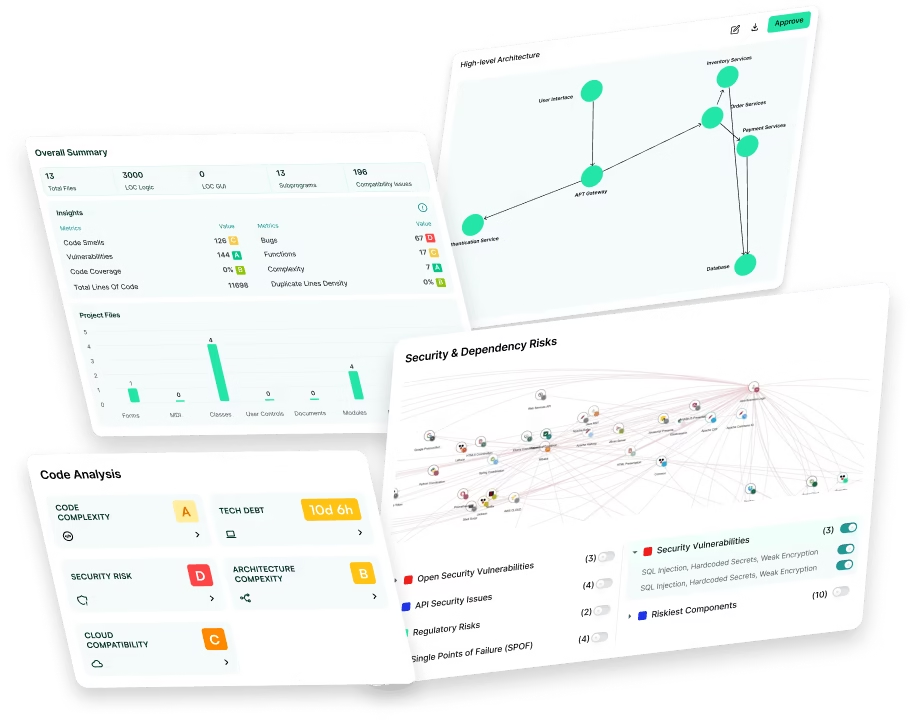
- Extracted business logic, workflows, APIs, and dependencies from undocumented ColdFusion applications
- Generated interactive flowcharts, dependency maps, and structured documentation
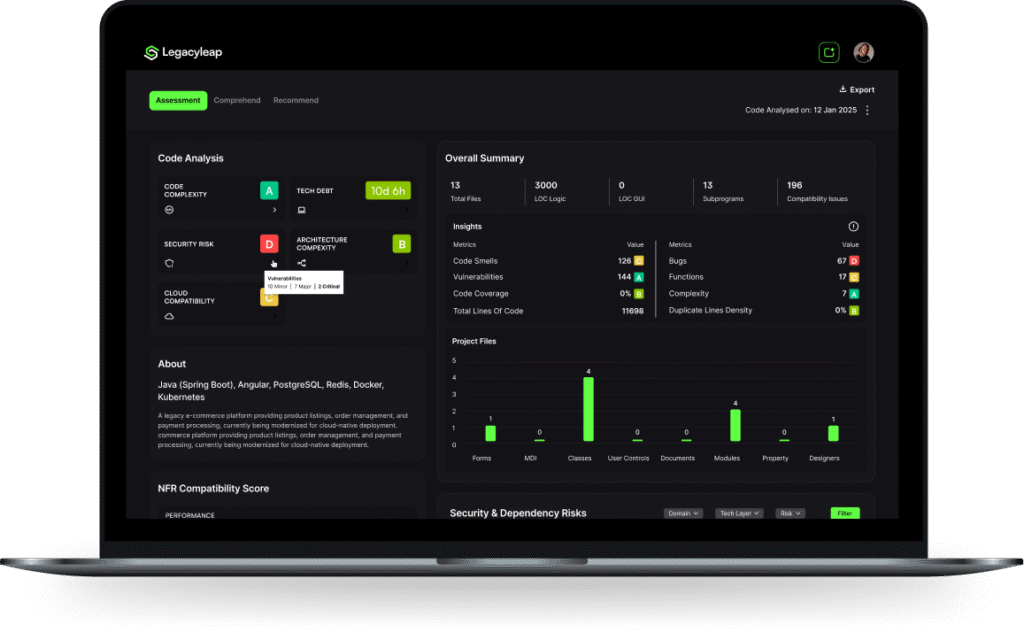
- Augmented SonarQube with AI-powered analysis to detect deeply embedded bugs and cognitive complexity
- Delivered a fitment score for each application to evaluate modernization approach and confirm alignment with the .NET-first strategy
Phase 2 – ColdFusion to PHP
- Applied automated code transformation to accelerate the ColdFusion-to-PHP conversion
- Auto-generated unit tests, integration tests, API test suites, and UI test cases from the documentation produced in Phase 1
- Developed user stories with personas and acceptance criteria for functional parity validation
- Deployed on-premise AI middleware to execute transformation without exposing data to external LLMs
Phase 3 – PHP to .NET
- Executed the final PHP-to-.NET migration with full business logic preservation verified against the Phase 1 documentation baseline
- Ran differential regression testing between legacy and modernized outputs
- Delivered configurable AI middleware integration with the client’s internal LLM environment
- Confirmed deployment flexibility across AWS, on-premise, and hybrid Kubernetes infrastructure
Results
| Metric | Result |
|---|---|
| Modernization Speed | 60% faster than manual |
| Cost Savings | 40-50% vs. traditional |
| Data Exfiltration Incidents | Zero – firewall never breached |
| Business Logic Preservation | Zero disruption across all three migration phases |
| Documentation | Functional docs and comprehensive test cases auto-generated |
| Code Quality | Reduced technical debt and improved maintainability |
Legacyleap vs. Manual vs. SI Partner
| Legacyleap | Manual Rewrite | System Integrator | |
|---|---|---|---|
| Timeline | 60% faster than manual | Baseline | Comparable or longer |
| Cost | 40-50% lower | Baseline | Typically higher (headcount) |
| AI Governance Risk | Zero – on-prem, air- gapped | Depends on tooling | Often needs external SaaS |
| Documentation from Zero | Automated – generated Phase 1 | Manual, slow, incomplete | Varies by SI |
| Test Coverage from Zero | Auto-generated all phases | Manual, often deferred | Varies by SI |