
TL;DR
- Half of US enterprises say the system still works is the reason they haven’t modernized. A 2025 Saritasa survey of 504 US IT professionals found 62% still run legacy software and 43% cite security vulnerabilities as their top concern.
- Legacy integration complexity is already blocking next-generation AI initiatives. Gartner predicted in June 2025 that over 40% of agentic AI projects will be canceled by the end of 2027, largely due to legacy integration barriers.
- Incremental modernization pays back three to four times faster than a full rewrite. BayOne’s 2025 analysis found incremental programs deliver payback in 6-18 months versus 18-48 months for full rewrites, with no value realized until completion.
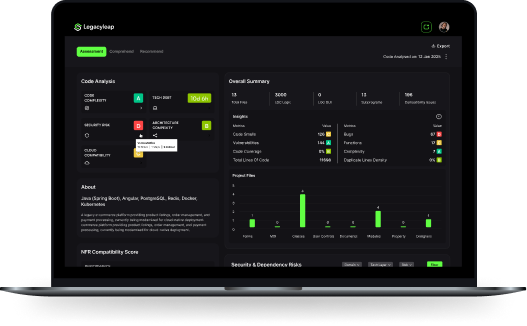
- Legacyleap’s Assessment Agent compresses weeks of manual dependency mapping into days. It produces a dependency map, risk heatmap, and modernization sequencing plan in 2-5 days without any source code leaving the client’s environment.
- A real case study involved untangling 327 VB6 files, 259 forms, and over 240,000 COM calls. Legacyleap executed a phased, GenAI-driven migration to C# for an insurance platform, keeping the system operational throughout via incremental decoupling.
Why Enterprises Are Choosing Incremental Modernization Over Full Rewrites
Half of US enterprises have not modernized their legacy systems for one reason: the system still works. That belief is costing them more than a full rewrite ever would.
According to a 2025 survey of 504 US IT professionals by Saritasa, 50% cited “the current system still works” as their primary reason for not upgrading. The same survey found that 62% of organizations are still running legacy software, and 43% say security vulnerabilities are their top concern, yet the status quo persists. [1]
Complacency is not a neutral position. As legacy systems age, maintenance costs climb, institutional knowledge leaves with retiring developers, and the architecture becomes less compatible with every modern platform the business wants to adopt.
The second reason most enterprises don’t act is risk. Full rewrites are expensive, time-consuming, and fail at a high rate. The organizations that have moved forward successfully have done so not by replacing everything at once, but by evolving systems from within.
This is why incremental modernization has become the practical path for enterprise modernization. It balances business continuity with technical evolution.
Done right, it lets you evolve architecture without breaking operations. You modernize while the business keeps running.
At Legacyleap, we’ve built our entire platform around this principle, enabling teams to modernize in place, safely, and continuously. This blog shows you how it’s done.
Why AI Initiatives Are Stalling, and What Legacy Systems Have to Do With It
Most organizations have AI initiatives on the roadmap. Most of those initiatives are stalling. The cause is rarely the AI itself.
HFS Research’s Legacy Application Modernization Services, 2025 report, drawing on a survey of 608 Global 2000 enterprises, found that enterprises still burdened by technical debt will be “locked out of the next wave of AI-native value creation.” [2]
A separate HFS Research and Publicis Sapient study of more than 600 IT and business leaders found that 41% cite difficulty integrating AI with legacy systems as a direct barrier to AI adoption. [3]
The technical reasons legacy systems block AI are specific:
- No real-time APIs. Most legacy systems communicate through batch processes and file-based integrations. Agentic AI requires low-latency, event-driven interfaces that legacy architectures were never designed to support.
- Siloed, inaccessible data. Modern AI models depend on unified, well-structured data. Legacy systems lock data in proprietary schemas, separate databases, and formats that AI pipelines cannot consume without significant transformation.
- Tightly coupled architecture. Monolithic systems cannot be connected to AI agents or analytics platforms without first being decoupled. There is no shortcut around this.
Gartner predicted in June 2025 that over 40% of agentic AI projects will be canceled by the end of 2027, and identified legacy integration complexity as one of the primary causes. [4]
The incremental sequence that unblocks AI fastest does not require a full rewrite. It starts with decoupling the specific components that block AI integration, such as exposing APIs, extracting data layers, and carving out the bounded logic that AI needs to interact with. This happens while leaving the rest of the system running.
Each increment delivers both operational value and AI readiness. That sequencing is what Legacyleap’s Assessment and Recommendation Agents are designed to produce.
What Incremental Modernization Looks Like in Enterprise Systems
This isn’t about updating one app at a time. That’s a rollout schedule, not a strategy.
Incremental modernization is about identifying modular units such as workflows, sub-domains, or discrete functional areas that can evolve independently without disrupting the systems around them. You’re not rewriting the system but reshaping it from within.
The shift is from application-level thinking to system behavior-level thinking:
- Instead of “modernize the whole billing app,” think: “decouple the invoicing workflow.”
- Instead of “move everything to microservices,” ask: “What domains can own their logic and scale independently?”
This is why modular thinking beats app-by-app replacement:
- It surfaces high-impact units sooner
- It reduces the blast radius
- It creates the flywheel for repeatable modernization, not isolated migrations
The goal isn’t to ship a new system. It’s to build a system that can keep changing safely, continuously, and without hitting pause on the business. This modular approach ensures that each cycle of incremental modernization reduces risk, accelerates ROI, and builds long-term adaptability.
Practitioners familiar with the Strangler Fig pattern will recognize the underlying logic. The Strangler Fig approach is the right conceptual foundation, i.e., routing traffic away from legacy components toward new implementations gradually, until the legacy system can be retired.
Where Gen AI extends is in the comprehension layer that comes before any routing decision is made. The Strangler Fig tells you how to migrate a component. It does not tell you which component to start with, what that component actually depends on, or what business logic is embedded in it.
Legacyleap’s Assessment Agent compresses the discovery work that typically takes weeks of manual analysis into 2–5 days, surfacing the dependency map, risk indicators, and sequencing logic that makes the Strangler Fig approach executable rather than theoretical.
How Enterprises Modernize Legacy Systems Without Downtime
You don’t need to touch everything at once. And you definitely don’t need to start with the hardest part of the system.
The key to incremental modernization is sequencing and identifying areas where you can introduce change without disrupting core workflows.
Here’s how the smartest teams approach it:
- Start with “read” before “write.” Reporting, search, and analytics are great first candidates. They touch production data but don’t change it, making them safer to replatform or rebuild as services.
- Modernize around high-change zones. Domains like pricing, promotions, or customer-facing integrations change frequently. That volatility is a signal: decoupling here pays off fast.
- Look for modernization accelerants; parts of the system that have clear boundaries, are lightly coupled to other components, and deliver value even when modernized in isolation.
These accelerants allow enterprises to adopt a modernization-without-downtime strategy and show measurable impact quickly.
This approach is also financially validated. According to BayOne’s 2025 analysis of enterprise modernization programs, incremental approaches deliver payback in 6–18 months.
Full rewrites typically take 18–48 months to deliver equivalent functionality, and benefits are only realized after complete implementation. The gap is not marginal. It is the difference between a program that builds internal confidence cycle by cycle and one that requires sustained faith in an outcome that is always 18 months away.
Legacyleap’s Gen AI agents help identify these low-resistance entry points by analyzing:
- Code coupling
- Usage frequency
- Change history
- Domain-level volatility
Why this matters: Incremental doesn’t mean random. Sequence matters. Pick the right starting points, and you build momentum, not just modern code.
One concern that regulated US enterprises consistently raise at this stage is security during the coexistence period, when legacy and modern systems are running in parallel.
This is a legitimate operational concern: 43% of US IT professionals cite security as their top concern in legacy environments, according to the Saritasa 2025 survey. [1] During parallel operation, authentication boundaries must be explicitly defined so that sessions, credentials, and access controls do not bleed between the legacy and modern layers.
For healthcare, financial services, and other regulated industries, this includes maintaining audit trail continuity across both systems, as regulators do not accept a gap in the audit record because a migration was in progress.
Legacyleap’s governance layer and full traceability from legacy to modernized output are specifically designed to address this requirement.
5 Enterprise Modernization Mistakes That Increase Risk and Delay ROI
The blockers to modernization aren’t always technical. Often, they’re assumptions that are widely held, rarely questioned, and deeply costly.
Let’s break them down.
Mistake 1: Waiting Because “The System Still Works”
The most common reason US enterprises delay modernization is not technical. It is organizational: the system still works, so the urgency never arrives.
The Saritasa 2025 survey of 504 US IT professionals confirmed this directly, with 50% citing “the current system still works” as their primary reason for not acting.
The problem with that reasoning is timing. The best moment to modernize is while the system is stable, teams have context, and there is room to plan. Waiting until a legacy platform fails leads to rushed, patchwork solutions under pressure.
Every quarter of delay also narrows the window for doing it safely: institutional knowledge walks out with retiring developers, compliance requirements tighten, and the architecture becomes less compatible with the modern platforms the business needs.
Gartner’s June 2025 research on agentic AI stalls reinforces this from the other direction — over 40% of agentic AI projects will be canceled by the end of 2027, with legacy integration complexity as a leading cause. The organizations waiting to modernize are quietly closing the door on the AI programs they have already approved.
What helps: A scoped assessment that shows exactly what the system depends on, where the risk is concentrated, and what a sequenced first step looks like, before any commitment is required.
Mistake 2: “We need to fix all tech debt first.”
No, you don’t. Fix what’s in the path of value delivery. Some debt can be isolated. Some can be wrapped. All of it doesn’t need to block progress.
What helps: Component-level risk scoring to know what’s worth touching and what’s not.
Also read: How to Identify and Address Technical Debt in Legacy Applications
Mistake 3: “We have to finish cloud migration first.”
Cloud migration and incremental modernization do not need to happen sequentially. In practice, they should happen in parallel. And in 2025–2026, AI readiness requirements are the reason why.
Enterprises waiting for cloud migration to complete before touching legacy code are deferring the architectural work that makes AI initiatives viable. Decoupling APIs, extracting data layers, and carving out modular components are the same steps that enable cloud-native deployment and AI integration.
Running both workstreams in parallel is not complex. It is the most efficient path to both outcomes simultaneously.
What helps: A modernization approach that works across on-premises, hybrid, and cloud environments, not one that requires a clean post-migration baseline to begin.
Mistake 4: “Microservices are the only valid end state.”
They’re a tool, not a goal. The right target might be modular monoliths, domain-aligned services, or just cleaner boundaries within a single system.
What helps: Architecture guidance aligned to business structure, not tech trends.
Also read: Monolith vs Microservices Architecture: When, Why, and How
Mistake 5: “We’ll get to it after the next product release.”
You won’t. Because the next release has another one behind it. Modernization doesn’t compete with delivery. It gets embedded into it.
What helps: Feedback loops inside your delivery pipelines, where modernization tasks ride along with product cycles.
At Legacyleap, we’ve designed our platform to systematically address these through real-world signals:
- Automated dependency maps
- Gen AI-led logic surfacing
- Risk heatmaps at the component level
- Incremental rollout support inside active delivery workflows
Most stalled efforts didn’t fail on execution. They failed on assumptions. Address the assumption, and the path forward gets a lot clearer.
Incremental Modernization vs Full Rewrite: Risk, Cost, and Delivery Impact
| Criteria | Incremental Modernization | Full Rewrite |
| Approach | Modernizes one module or service at a time, driven by business priorities | Rebuilds the entire system from scratch in a single initiative |
| Risk Management | Controlled risk with fallback to legacy modules if needed | High risk due to all-or-nothing switchover |
| Time to Value | Delivers value from the first modernized component | Long ramp-up; value realized only post-launch |
| System Downtime | Zero downtime with legacy and modern systems running in parallel | Likely downtime or service degradation during cutover |
| Technical Debt Handling | Prioritizes and addresses technical debt incrementally | Attempts to eliminate all tech debt at once, often impractical |
| Change Adaptability | Easily accommodates mid-course corrections or reprioritization | Difficult to pivot once rewrite path is defined |
| Cost Efficiency | Costs are spread out, allowing phased budgeting and ROI tracking. Payback typically 6–18 months | High upfront investment; payback typically 18–48 months with value only on completion |
| Gen AI Leverage | Enables AI-driven discovery, testing, and orchestration at each step | Requires upfront documentation and high planning accuracy for AI to be effective |
| [NEW] Organizational Disruption | Engineering teams continue active delivery alongside modernization; no dedicated rewrite team required | Requires dedicated rewrite team, often pulling senior engineers off product delivery for 18–48 months |
| [NEW] Requirements Change Tolerance | New requirements are absorbed into the next increment without derailing the program | Mid-program scope changes require renegotiating the entire rewrite plan, a common cause of budget overruns and cancellations |


How Incremental Modernization Creates Repeatable Delivery Momentum
Incremental modernization works because it builds momentum. Each cycle delivers value, reinforces confidence, and creates the blueprint for what comes next.
Here’s what the loop looks like in practice:
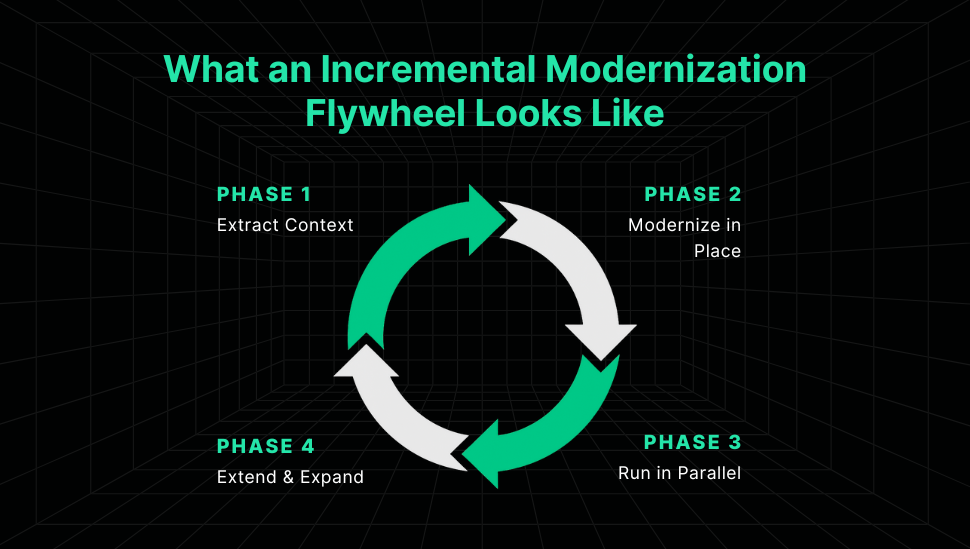
1. Identify Business Logic, Dependencies, and Change Risk
Start with visibility. Not just code, but how that code is used.
- Analyze source code, dependency graphs, and historical change logs
- Map business logic to real workflows, not just file structures
- Gather input from delivery teams who know what breaks and why
This phase sets the foundation. You’re not just looking for what’s outdated. You’re looking for where the risk is low, and the upside is high.
2. Decouple and Modernize High-Change Components First
Avoid the temptation to replace. Instead, reshape the system from within.
- Wrap legacy modules in service interfaces
- Carve out high-change subdomains: pricing, auth, reporting
- Refactor high-friction components while preserving system contracts
The goal is progress with minimal disruption. Even a small rewrite creates scaffolding for future change.
3. Validate Modern Components Alongside Legacy Systems
Deploy the modernized unit alongside legacy components, not instead of them.
- Mirror functionality to test output and behavior
- Use feature toggles, proxies, or shadow traffic to validate real usage
- Monitor performance, error rates, and change impact in isolation
This phase builds confidence without consequence. If something fails, the legacy fallback is still live.
The most common technical objection raised by US practitioners at this stage is data consistency: when legacy and modern systems are both live, which system is the source of truth, and how do you prevent state divergence?
The answer depends on the scope of the increment. For read-only components such as reporting, analytics, and search, the legacy system remains the write source, and the modern component consumes a replicated or streamed feed.
For components that write state, an anti-corruption layer or event broker mediates between the two systems, translating writes so that both layers remain consistent during the transition window. The critical discipline is defining the consistency contract explicitly at the start of each increment, not resolving it reactively when divergence is discovered in production.
4. Reuse Proven Modernization Patterns Across Other Domains
Once the first success lands, don’t reinvent. Scale what worked.
- Reuse deployment pipelines, logging standards, and service templates
- Apply learnings to the next domain, with fewer unknowns
- Allow architecture to emerge through validated patterns, not theoretical blueprints
Each cycle makes the next one easier, faster, and safer. That’s how modernization becomes part of delivery, not an initiative outside of it.
One failure mode that the flywheel model needs to address explicitly: without defined exit criteria, incremental modernization becomes a program that never ends.
Three conditions signal that a legacy component is ready to decommission.
- First, the modernized replacement has passed differential parity testing against the legacy system across all documented business rules and edge cases.
- Second, the modernized component has operated in parallel with live production traffic for a defined period (typically one to three release cycles) with no behavioral divergence.
- Third, audit trail continuity has been confirmed, meaning the governance record from the legacy component to the modernized version is complete and regulator-ready for industries where this is required.
When all three conditions are met, the legacy component can be retired with confidence. Until then, it stays live.
This flywheel lies at the heart of scalable enterprise modernization, enabling organizations to sustain transformation continuously without the all-or-nothing risk of a full rewrite.
Enterprise Checklist for Starting Incremental Modernization Safely
- Identify modernization triggers. Flag legacy bottlenecks as entry points: unsupported technology, compliance risk, performance failures, or components blocking AI integration. Starting where the pain is visible creates internal momentum for the broader program.
- Map interdependencies. Don’t underestimate this step. Dependency mapping is where most incremental modernization programs stall. Manual mapping takes weeks, produces inconsistent outputs, and still misses hidden coupling. Legacyleap’s Assessment Agent replaces this bottleneck by automatically producing a dependency map, risk heatmap, and architecture overview in 2–5 days. It becomes a sequenced starting point that tells you exactly which components are safe to decouple first.
- Select low-risk, high-value domains. Start with non-customer-facing areas: reporting layers, internal APIs, or administrative workflows with clear boundaries and limited downstream dependencies. Early wins here give the team a reusable delivery pattern before touching mission-critical components.
- Define modular rollout boundaries. Break modernization scope into self-contained increments with explicit entry conditions, exit criteria, and handoff points. Each increment should be deliverable and testable independently. Poorly defined boundaries are the most common reason incremental programs drift back toward big-bang behavior.
- Run legacy and modern in parallel, and maintain audit trail continuity. Maintain legacy availability while validating modern components in production. For regulated industries, this requires explicit attention to audit trail continuity. Regulators expect an unbroken record of system behavior. Define the logging handoff before parallel operation begins, not after.
- Track impact per cycle. Measure delivery time, defect rates, and performance changes for every increment. These metrics validate that the approach is working and give internal stakeholders the evidence base to justify continued investment.
- Document reusables for the next round. Capture the patterns, automation logic, and test cases that worked in the current increment. Each cycle should take less time than the last. If documentation is treated as optional, the compounding efficiency gains of the flywheel model are lost.
Steps 1 through 3 of this checklist (identifying triggers, mapping dependencies, and selecting the right starting domain) are exactly what Legacyleap’s $0 codebase assessment delivers.
Get Your Modernization Roadmap → Dependency map, risk heatmap, and sequencing plan. 2–5 business days. No commitment required.
A Case Study: How a UK Retailer Modernized Core Domains Without a Full Rewrite
“A complex system that works is invariably found to have evolved from a simple system that worked.”
– Gall’s Law
The following case study describes work led by Legacyleap’s CTO, Rajat Singhal, before his role at Legacyleap. Included here to illustrate the incremental approach in a real enterprise context.
When leading digital transformation for a major UK retailer, the team deliberately avoided a full rewrite. Instead, they carved out domains like Pricing and Promotions, built modern microservices, and maintained safe communication with their legacy Oracle system via an anti-corruption layer.
Each change delivered business value quickly. Nothing broke. Over time, what began as incremental fixes became a system capable of rapid innovation.
“This methodical evolution (NOT revolution) approach paid dividends. Each incremental change delivered tangible business value without disrupting operations. The system grew more flexible and resilient over time, ultimately enabling innovation at a pace that would have been impossible with our monolithic architecture.”
– Rajat Singhal, CTO, Legacyleap
The same incremental principles, now accelerated by Legacyleap’s Gen AI agents, have delivered comparable outcomes for enterprise clients.
In one engagement, a major insurance platform running 327 VB6 files, 259 forms, 9,612 controls, and 240,000+ COM calls had become impossible to scale or maintain. Rather than a full rewrite, Legacyleap executed a GenAI-driven, phased migration to C#, eliminating dependencies incrementally, consolidating executables, and automating test generation at each step. The system remained operational throughout.
Why Delaying Incremental Modernization Increases Operational Risk
Most enterprises have already approved AI initiatives. Agentic AI programs, machine learning pipelines, and real-time analytics investments are on the roadmap and, in many cases, already funded. What those programs share is a dependency on infrastructure that most legacy estates cannot support today.
Gartner’s June 2025 prediction that over 40% of agentic AI projects will be canceled by the end of 2027 does not mean agentic AI doesn’t work. It means organizations are launching AI programs against infrastructure that structurally cannot deliver the outcomes those programs require.
Every quarter that legacy modernization is deferred is a quarter in which already-approved AI investment produces diminishing returns against architectural barriers that were always going to surface.
The organizations moving forward are not doing so because they have more budget or more risk appetite. They are doing so because they recognized that modernization is not a separate initiative from AI readiness. It is the prerequisite.
Incremental modernization isn’t about moving slowly. It’s about moving intentionally, with the flexibility to adapt, the structure to deliver, and the tools to accelerate without disruption. Each modular change reduces operational risk, improves AI readiness, and builds the delivery confidence that compounds across every subsequent increment.
Wrapping Up,
The organizations that modernize successfully don’t start with a transformation program. They start with a clear picture of what they actually have.
Legacyleap’s $0 codebase assessment is designed for exactly this moment. Upload your legacy codebase, or a representative portion of it, and receive:
- A dependency and module map showing how your system is connected and where coupling risk is concentrated
- A risk heatmap identifying the components with the highest technical debt and compliance exposure
- Architecture observations surfacing the patterns, anti-patterns, and structural issues that affect sequencing decisions
- A modernization sequencing plan with recommended starting points, effort ranges, and migration targets
- An SBOM (Software Bill of Materials) overview for regulated industries that require asset-level visibility
The assessment is completed in 2–5 days. No source code leaves your environment. No commitment is required. It has been used by enterprises in financial services, healthcare, insurance, and manufacturing, typically as the first step in a program that would otherwise spend weeks on manual discovery.
US enterprises that have gone through the assessment consistently report the same outcome: the sequencing plan changes, which component they planned to start with, because the dependency map surfaces risk that was invisible before the analysis.
FAQs
The Strangler Fig pattern describes how to migrate a component: routing traffic away from legacy code toward a new implementation gradually until the legacy layer can be retired. Incremental modernization is the broader strategy covering which components to start with, in what sequence, and how to validate each step. Legacyleap’s Assessment Agent compresses the discovery work that makes the Strangler Fig executable, surfacing the dependency map and sequencing logic in 2 to 5 days instead of weeks.
Yes, and this is one of its primary advantages over full rewrites. Incremental modernization is designed to embed into existing delivery cycles rather than compete with them. Modernization tasks are scoped as bounded increments with clear entry and exit criteria, so they ride alongside sprint work without pulling engineers off product commitments. The key discipline is sequencing: modernization work should target components not in active feature development, reducing the risk of conflicting changes during the transition window.
According to BayOne’s 2025 analysis, incremental programs typically deliver payback in 6 to 18 months. Full rewrites take 18 to 48 months and deliver no value until completion. [5] The first increment, often a reporting layer, an internal API, or a high-change subdomain, frequently delivers measurable operational improvement within the first quarter. Subsequent increments build on the patterns established in the first, compressing delivery time as the program matures.
For read-only components, the legacy system remains the write source and the modern component consumes a replicated or streamed feed. For write-capable components, an anti-corruption layer or event broker mediates between the two layers to keep both consistent during the transition window. The critical practice is defining the consistency contract explicitly before parallel operation begins, not resolving it reactively when divergence surfaces in production.
Three conditions must be met. First, the modernized replacement has passed differential parity testing across all documented business rules and edge cases. Second, it has run alongside live production traffic for a defined period, typically one to three release cycles, with no behavioral divergence detected. Third, for regulated industries, audit trail continuity has been confirmed and the governance record is regulator-ready. When all three conditions are satisfied, the legacy component can be decommissioned with confidence.
Legacy systems block AI adoption for three structural reasons: no real-time APIs, siloed data that AI pipelines cannot consume, and tightly coupled architecture that cannot be connected to AI agents without modification. Incremental modernization addresses each in sequence, exposing API surfaces, decoupling data layers, and carving out modular components that agents need to interact with, without requiring a full rewrite first. Each increment simultaneously delivers operational value and increases AI readiness.