
When Visual Basic 6.0 launched in 1998, it dominated the landscape. Two-thirds of all business application programming on Windows PCs ran on Visual Basic, with nearly 3.5 million developers worldwide. That scale is now the problem.
In 2026, thousands of US enterprises still run revenue-critical systems on VB6. The Stack Overflow Developer Survey 2024 found that Visual Basic is actively used by just 4.1% of professional developers globally. [1]
The engineers who understand VB6’s COM interop quirks, proprietary ActiveX mappings, and undocumented business logic are leaving the workforce faster than they can be replaced. VB6 applications cannot run in containers or on Linux, putting them outside most modern cloud architectures.
And in regulated industries, the gap between VB6 and current security standards surfaces in audits. Application modernization is now the top technology priority for 71% of CIOs globally, according to Gartner’s 2026 CIO Agenda. [2]
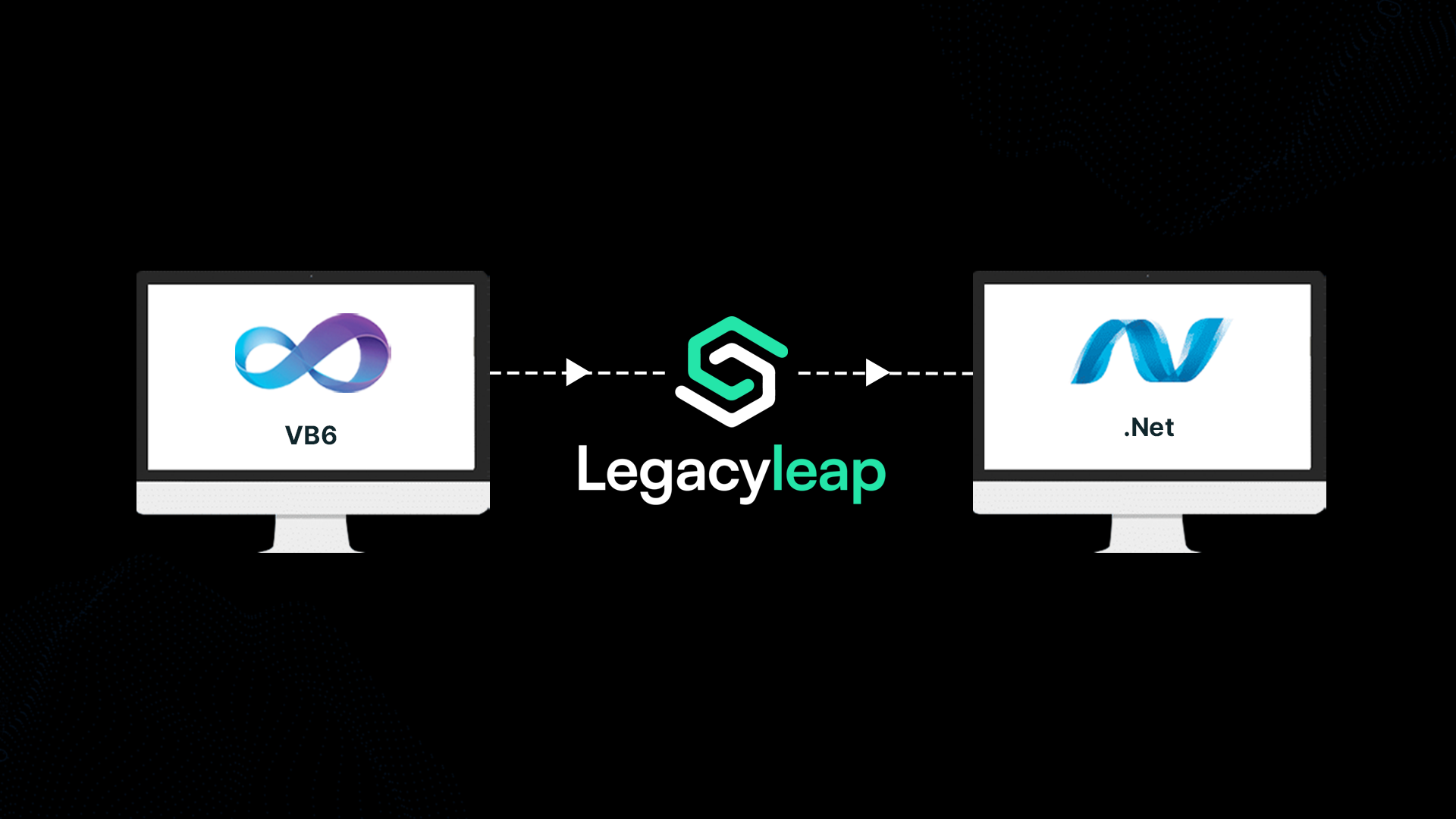
The question is how to migrate without breaking the business in the process. This article explores how Generative AI, when combined with human expertise, changes the VB6 to .NET migration equation, and where the limits of that approach lie.
Why VB6 to .NET Migration Projects Fail
Modernizing legacy systems like VB6 to .NET is often a complex and labor-intensive endeavor. While VB6 was once a dominant platform, its outdated architecture now presents significant drawbacks.
Applications built on VB6 carry an extremely high security risk score of 9.3 out of 10, a reflection of outdated security protocols, high maintenance costs, and operational inefficiencies that make modernization essential.
Migrating from VB6 to .NET isn’t a straightforward upgrade. Organizations typically find themselves dealing with deeply embedded legacy code, complex interdependencies, and outdated components. A typical enterprise VB6 application may have hundreds of thousands of lines of code spread across numerous external components, each one a potential complication in the transition.
.NET 10, released in November 2025 as a Long-Term Support release and supported until November 2028, offers superior performance, scalability, security, and community support. It is the recommended migration target for enterprises starting work in 2026.
Teams already mid-migration on .NET 8 (LTS) should note that .NET 8 reaches end of support in November 2026 and plan their upgrade path accordingly. But even with a clear destination, the traditional modernization path is slow and error-prone.
Migration tools exist, but they require significant manual intervention to address missing features, code incompatibilities, and architectural gaps.
Many enterprises also face a skills gap, VB6 developers are increasingly rare, resulting in higher costs and project delays.
VB6 to .NET Component Replacement Reference
Before migration begins, every third-party control and COM component needs to be inventoried. The table below covers the most commonly encountered components and their .NET equivalents.
| VB6 Component | .NET Equivalent |
| ADO / DAO data access | Entity Framework Core or Dapper |
| ActiveX controls (MSComCtl, SSTab, etc.) | Custom .NET controls or third-party replacements |
| Crystal Reports | SSRS, FastReport, or Telerik Reporting |
| CommonDialog | OpenFileDialog / SaveFileDialog in .NET |
| ADODB.Connection | SqlConnection or EF Core DbContext |
| MSFlexGrid / DataGrid | DataGridView (WinForms) |
| VB6 Forms | WinForms |
| VBScript / COM automation | .NET interop or full rewrite |
| FileSystemObject | System.IO namespace |
| On Error GoTo (error handling) | try-catch blocks in .NET |
VB6 Compliance Risk in Regulated Industries
For US enterprises in regulated industries, the compliance case for migration is as urgent as the technical one.
- Healthcare: VB6 lacks the built-in audit trails, data encryption standards, and access controls required for HIPAA compliance. The Change Healthcare breach, detected in February 2024 and confirmed in January 2025 as affecting 190 million people, making it the largest healthcare data breach in US history [3], illustrates what happens when legacy systems fall behind modern security standards. Running unpatched VB6 in clinical or administrative workflows creates significant HIPAA compliance risk.
- Finance: SOX compliance requires documented, auditable controls over financial reporting systems. VB6’s absence of structured logging, monitoring, and patch history makes it difficult to demonstrate control effectiveness to auditors. SEC and FINRA examinations are increasingly flagging unsupported technology as an operational risk.
- Government and defense: FedRAMP cloud authorization requirements are incompatible with VB6’s architecture. Federal contractors running VB6 face direct compliance barriers when migrating workloads to Azure GovCloud or AWS GovCloud.
Running VB6 in a HIPAA, SOX or FedRAMP-regulated environment? Talk to a Migration Specialist.
How Gen AI Changes the VB6 Migration Equation and Where Human Oversight Is Still Essential
Traditional VB6 to .NET modernization involves a highly manual process with labor-intensive code refactoring, dependency mapping, and error resolution that leads to long timelines and high costs.
Generative AI introduces a more efficient approach. By automating critical tasks like code conversion, documentation generation, and error detection, Gen AI can reduce modernization cycle times by up to 40% while improving codebase understanding by over 2x.
Yet it is not a one-size-fits-all solution. Human oversight remains crucial for guiding and refining the process, particularly for complex business logic, proprietary algorithms, and architectural decisions.
The following sections explore this balance, covering where Gen AI genuinely outperforms traditional methods, why human expertise remains indispensable, and where the combination makes the greatest impact.
How Gen AI Accelerates VB6 to .NET Migration: Real Use Cases
The use cases below reflect what Gen AI tooling can deliver in a VB6 migration context generally. The client outcomes that follow each use case are Legacyleap engagements.
1. Code Conversion
Unlike traditional conversion tools that rely on rigid rule-based algorithms, Gen AI adapts to code patterns, making it more effective at handling edge cases and complex business logic. This reduces the time and effort required for manual rewriting while minimizing human error.
Financial Services | VB6 → C# | 70–80% code conversion acceleration
Legacyleap used Gen AI to automate the conversion of a complex VB6 system handling core business logic and financial transactions. The platform accelerated code conversion by 70–80%, ensured compliance with strict financial regulations, and delivered measurable improvements in security and scalability.
2. Process Automation
Gen AI automates many of the repetitive tasks that bog down modernization projects like documentation generation, test case creation, and regression testing. AI-driven tools can automatically document VB6 codebases before migration and generate unit tests to ensure the .NET version maintains the same functionality.
Fuel Distribution | VB6 → .NET | 70% automation | 80% manual effort reduction
Gen AI automated 70% of code transformation and testing for a VB6 system where a full rewrite had been deemed too expensive. Manual effort dropped by 80%, costs by 60%, and feature deployment accelerated by 40%, with zero downtime.
3. Error Detection and Code Refactoring
Traditional modernization methods often struggle to detect hidden bugs in legacy code. Gen AI can analyze VB6 code at scale to identify memory leaks, inefficiencies, and outdated functions, then recommend refactoring options or rewrite portions directly to improve performance and security.
Semiconductors | VB6 → .NET Framework | 70% process automation | 40% speed improvement
Legacyleap’s Gen AI platform automated 70% of manual processes on a fragmented VB6 stack controlling real-time hardware interactions. Application speed improved by 40% while precision hardware communication was maintained throughout.
4. Code Comprehension and Documentation
Gen AI can analyze complex legacy code structures, generate documentation, and produce visual representations like flowcharts and dependency diagrams, giving developers a working map of a codebase that may never have been properly documented.
Entertainment | VB6 + WinForms → .NET | 1,700 DLLs | 60% conversion acceleration
Legacyleap modernized a system comprising 1,700 DLLs and a fragmented architecture limiting the business’s scalability. Gen AI automated code conversion, optimized SQL Server performance, and delivered a modular, cloud-ready .NET system.
Where Gen AI outperforms traditional methods
In scenarios requiring repetitive tasks or data-heavy analysis, Gen AI excels. The ability to scan vast amounts of legacy code and produce high-quality, automated output far surpasses manual methods.
In areas like automated testing and bug detection, AI tools can continuously learn and improve, providing more accurate predictions and refactoring suggestions than traditional rule-based tools.
For businesses, this means faster results, fewer errors, and reduced costs.
In a project with a financial services provider, we saw a 30% reduction in code migration time when using Gen AI to analyze and convert a 600,000 LOC VB6 system with 3,800 modules. The AI was able to automate 70% of the conversion, significantly reducing manual efforts.
It also scanned the code for redundancies and optimized the output, allowing the team to meet aggressive project deadlines with a high level of accuracy.
The need for human oversight
Despite its potential, Gen AI is not a silver bullet. It still requires human oversight to ensure quality and alignment with business goals.
AI models can struggle with complex, highly customized VB6 applications where implicit business logic or proprietary algorithms are involved. Human developers are needed to refine AI-generated code, address edge cases, and ensure that third-party integrations are maintained.
In a project with a manufacturing client, we used a Gen AI tool to convert a 1.2 million LOC VB6 system. However, the highly customized nature of the legacy codebase, comprising 6,500 files, meant that 40% of the generated output required significant manual tweaking.
The AI struggled to interpret certain proprietary algorithms, and while it handled routine parts of the code well, it required human intervention for custom modules and integration points.
Additionally, AI’s limitations in understanding long-term architectural requirements mean that human architects must guide the modernization strategy to avoid technical debt.
Where Gen AI makes the most impact
Gen AI delivers the greatest value in tasks that are repetitive, data-driven, or require large-scale code analysis. It is particularly useful in the early stages of modernization (code conversion, testing, and documentation), where automation can reduce the workload on developers.
However, for more complex modernization tasks like architectural redesign, integrating third-party controls, and aligning the modernized application with business requirements, human expertise remains indispensable.
Gen AI acts as an accelerator in these processes, but it is not yet mature enough to replace skilled developers and architects in managing the intricacies of VB6 to .NET migrations.
Challenges and Limitations of Gen AI in Modernization
AI tools offer significant potential for speeding up VB6 to .NET migration. But many of these tools are still in their infancy when it comes to handling the intricate details of complex, enterprise-scale modernization projects.
Below is an honest look at the most commonly used tools, including their strengths, and where they fall short.
Popular VB6 to .NET Migration Tools Compared
1. ArtinSoft Visual Basic Upgrade Companion (VBUC)
Designed specifically for VB6 to .NET translation, supporting both .NET Framework and .NET Core. Strong on large, complex projects. Its limitation is output quality because generated code frequently needs significant manual adjustment for complex VB6 features and poorly structured legacy code.
2. VB Migration Partner
Focuses on VB6 to VB.NET conversion with high syntactic accuracy. Supports ActiveX controls and DAO data access, integrates with Visual Studio. Struggles with heavy COM interop and extensive third-party library dependencies, leaving developers to resolve compile errors and runtime issues manually.
3. CodeShift VB
An AI-assisted conversion tool targeting VB6 to VB.NET migration. Applies machine learning to handle a broader range of syntax patterns than rule-based tools. Context window constraints limit its effectiveness on large multi-file projects with complex interdependencies.
4. Microsoft Copilot and GitHub Copilot
General-purpose AI coding assistants useful for accelerating individual tasks within a larger migration project. Not designed for migration-specific workflows. Their understanding of legacy VB6 constructs such as business logic, COM dependencies, and late-bound Variant types is limited. Best used alongside developers who already understand what the code does.
5. ChatGPT
Useful for explaining VB6 constructs and guiding strategy on isolated problems. For small codebases it can assist meaningfully with syntax translation. At enterprise scale, it loses project-level context and cannot trace COM dependency graphs across hundreds of modules, making it insufficient for comprehensive VB6 to .NET migration.
6. Claude Code
Anthropic’s agentic coding tool offers a larger context window than most general-purpose AI assistants and a subagent system that handles large codebases without context pollution. A meaningful step up from ChatGPT for comprehension and refactoring tasks, but still a developer tool with no VB6-specific workflows, dependency mapping, or ActiveX resolution built in.
| Tool | Best for | VB6-specific | Automation depth | Key limitation |
| VBUC | Large projects needing .NET Framework or Core output | Yes | High on syntax conversion | Output requires significant manual remediation |
| VB Migration Partner | Teams migrating to VB.NET step-by-step | Yes | Strong on syntax, weaker on COM | Struggles with heavy COM interop and third-party libraries |
| CodeShift VB | Teams migrating to VB.NET with AI assistance | Partial | AI-assisted, context-window limited | Manual replacement needed for unrecognized controls |
| Microsoft / GitHub Copilot | General development acceleration | No | File-level suggestions only | No migration-specific workflows or VB6 depth |
| ChatGPT | Small codebases, isolated syntax questions | No | Useful under ~9,000 LOC | Loses project-level context at enterprise scale |
| Claude Code | Developers wanting agentic assistance with large codebases | No | Strong on comprehension and refactoring with large context | No VB6-specific workflows, dependency mapping, or ActiveX resolution |
| Legacyleap | Enterprise VB6 with complex COM and missing documentation | Yes | 70% automated — docs, transformation, testing | Managed service, not a self-service license |
Want to see how Legacyleap handles your specific VB6 codebase? Book a 30-Minute Technical Demo.
Limitations of Current Gen AI Tools and the Overall Landscape
The tools above each address a portion of the VB6 migration problem. None of them addresses it completely. Key challenges shared across all of them include limited context understanding at the project level, inadequate handling of undocumented business logic, and no resolution path for orphaned third-party controls from vendors who no longer exist.
The broader landscape problem compounds this. Legacy modernization is not a single task but a sequence of distinct workstreams: codebase comprehension, dependency mapping, code conversion, architectural refactoring, test generation, and quality assurance. Each workstream has its own tooling requirements.
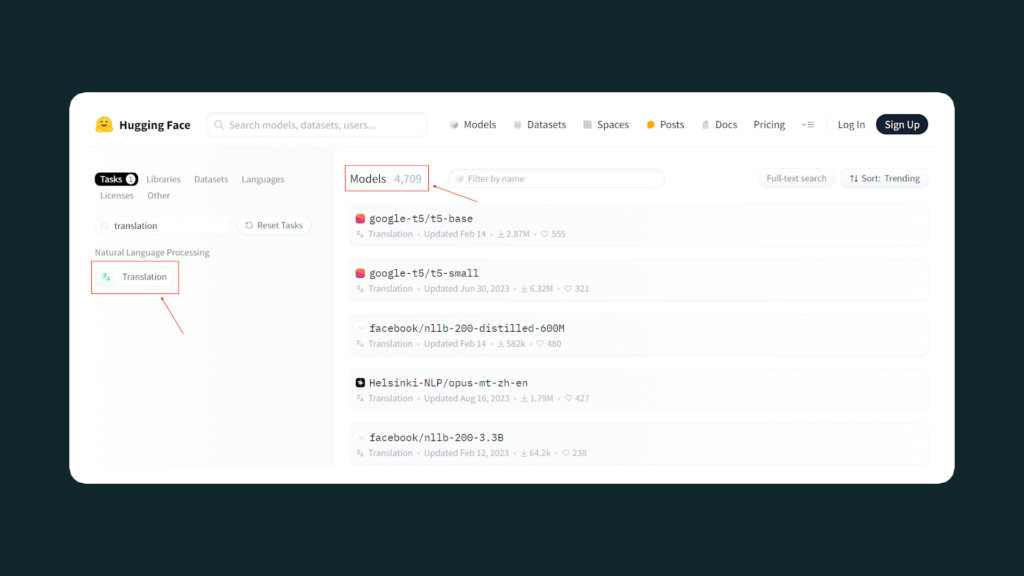
A search for translation-focused Gen AI models on Hugging Face returns over 4,700 results for that single task alone. Evaluating, selecting, and integrating the right tool for each stage of a migration is itself a significant project, one that most enterprise teams cannot run alongside an active migration program.
Gen AI has meaningfully reduced effort on several migration tasks. But it has not yet relieved teams of the judgment required to know which tools to use, when to use them, and when to set them aside.
For more on where migration programs stall, see Why most VB6 migration projects fail.
Legacyleap: An All-in-One VB6 to .NET Migration Solution
The challenge isn’t that traditional methods don’t work. It’s that they demand considerable effort and judgment at every stage, making it harder to meet today’s speed and agility demands.
Legacyleap combines the efficiency of Gen AI with the precision of human expertise, delivering a solution that not only automates but strategically guides the modernization journey.
Purpose-built for VB6 to .NET
Most modernization platforms are general-purpose. Legacyleap is not.
Years of research and production experience have shaped a platform designed specifically for VB6 to .NET migrations, covering the entire process from code comprehension to deployment, including the stages that general-purpose tools leave to the team: dependency mapping, documentation reconstruction, ActiveX resolution, and business logic extraction.
Curated Gen AI tooling for each migration phase
We curate the Gen AI toolchain for each migration phase because no single AI model handles VB6 comprehension, conversion, testing, and validation equally well. Using the wrong tool at the wrong stage is where most AI-assisted migrations stall.
Our team selects and orchestrates the right models per task, rather than applying a general-purpose model across everything and hoping for the best.
Full project context, not file-level processing
General-purpose AI tools process code at the file or function level. For enterprise VB6 systems with hundreds of interdependent modules and thousands of COM calls, file-level processing is structurally insufficient.
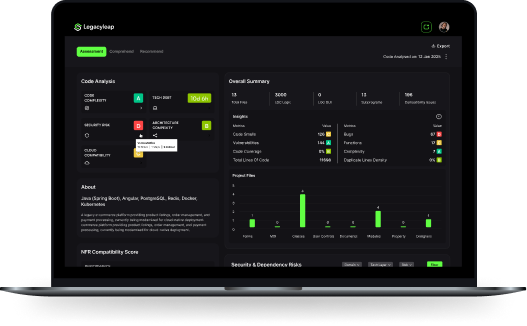
Legacyleap processes the entire codebase as a unified context, mapping dependencies across all files simultaneously. In a recent insurance engagement, the platform mapped 327 files and 242,613 COM calls, producing a complete dependency graph and business rule catalog that became the authoritative specification for the migration.
Automation where it is reliable, human oversight where it is not
Legacyleap automates up to 70% of the migration effort of documentation, transformation, and testing. The remaining 30% is handled by Legacyleap’s engineering team: architectural decisions, edge case resolution, compliance validation, and the business logic judgments that no automated system can make reliably. The goal is not maximum automation. It is a reliable outcome.
Results across VB6 engagements
| Outcome | Industry |
| 70–80% code conversion acceleration | Financial Services |
| 80% reduction in manual effort | Fuel Distribution |
| 60% conversion acceleration (1,700 DLLs) | Entertainment |
| 70% process automation | Semiconductors |
Strategic, end-to-end orchestration
Legacyleap aligns modernization with your business goals, streamlining each phase using Gen AI orchestration while minimizing disruption and maximizing long-term impact.
For US enterprises in regulated industries, the migration produces the audit artifacts, access controls, and validation evidence that regulators require, built into the process.
Looking to migrate VB6 to .NET with Gen AI? Get a Free VB6 Migration Assessment.
FAQs
In the U.S., VB6 to .NET migration work typically ranges from $90–$160 per developer hour, depending on legacy complexity, domain knowledge required, and modernization scope. Costs increase when undocumented business logic, COM dependencies, or regulatory constraints are involved, common in enterprise VB6 systems.
VB6 official IDE support ended on April 8, 2008. The VB6 runtime ships with Windows for compatibility purposes, but Microsoft only covers “serious regressions and critical security issues”. The IDE, tooling, and all third-party ActiveX controls are fully unsupported. For enterprises, this means no patches, no security updates, and no official support path.
The most common source of failure is undocumented business logic embedded in UI event handlers. In enterprise VB6 systems, 40–60% of business rules live inside button clicks, form loads, and grid cell changes. Conversion tools translate the syntax correctly but cannot distinguish a business rule from a display behavior. The output compiles and then fails in production when the extracted logic doesn’t behave as the original system did.
For small, well-documented codebases, general-purpose AI tools can assist with isolated syntax translation. At enterprise scale they run into fundamental limitations: they cannot hold a full multi-file VB6 project in context, cannot trace COM dependency graphs across hundreds of modules, and cannot resolve undocumented business logic. They are useful as productivity aids alongside experienced developers, not as primary migration engines.
The most effective framing shifts the conversation from migration cost to cost of delay. Developer rates for VB6 migration work run $90–$160/hour. Typical enterprise project cost is $250,000–$600,000+ per 100,000 lines of code. But the alternative of maintaining an unsupported system with a shrinking talent pool, increasing security exposure, and growing compliance risk compounds every year migration is deferred. For regulated industries, a single audit finding or breach event can exceed the full cost of migration.
References
[1] Stack Overflow Developer Survey 2024 — Technology: Programming, Scripting, and Markup Languages. https://survey.stackoverflow.co/2024/technology
[2] Gartner — 2026 CIO and Technology Executive Agenda. https://www.gartner.com/en/information-technology/insights/cio-agenda
[3] U.S. Department of Health and Human Services — Change Healthcare Cybersecurity Incident. https://www.hhs.gov/hipaa/for-professionals/special-topics/change-healthcare-cybersecurity-incident/index.html
[4] Microsoft Learn — Support Statement for Visual Basic 6.0 on Windows. https://learn.microsoft.com/en-us/previous-versions/visualstudio/visual-basic-6/visual-basic-6-support-policy